 Add to Chrome
 Add to Firefox
 Add to Edge
Deep learning fault detection
Papers and Code
Machine Learning-Based Framework for Real Time Detection and Early Prediction of Control Valve Stiction in Industrial Control Systems
Jan 18, 2026
Control valve stiction, a friction that prevents smooth valve movement, is a common fault in industrial process systems that causes instability, equipment wear, and higher maintenance costs. Many plants still operate with conventional valves that lack real time monitoring, making early predictions challenging. This study presents a machine learning (ML) framework for detecting and predicting stiction using only routinely collected process signals: the controller output (OP) from control systems and the process variable (PV), such as flow rate. Three deep learning models were developed and compared: a Convolutional Neural Network (CNN), a hybrid CNN with a Support Vector Machine (CNN-SVM), and a Long Short-Term Memory (LSTM) network. To train these models, a data-driven labeling method based on slope ratio analysis was applied to a real oil and gas refinery dataset. The LSTM model achieved the highest accuracy and was able to predict stiction up to four hours in advance. To the best of the authors' knowledge, this is the first study to demonstrate ML based early prediction of control valve stiction from real industry data. The proposed framework can be integrated into existing control systems to support predictive maintenance, reduce downtime, and avoid unnecessary hardware replacement.

HybridSolarNet: A Lightweight and Explainable EfficientNet-CBAM Architecture for Real-Time Solar Panel Fault Detection
Jan 06, 2026Manual inspections for solar panel systems are a tedious, costly, and error-prone task, making it desirable for Unmanned Aerial Vehicle (UAV) based monitoring. Though deep learning models have excellent fault detection capabilities, almost all methods either are too large and heavy for edge computing devices or involve biased estimation of accuracy due to ineffective learning techniques. We propose a new solar panel fault detection model called HybridSolarNet. It integrates EfficientNet-B0 with Convolutional Block Attention Module (CBAM). We implemented it on the Kaggle Solar Panel Images competition dataset with a tight split-before-augmentation protocol. It avoids leakage in accuracy estimation. We introduced focal loss and cosine annealing. Ablation analysis validates that accuracy boosts due to added benefits from CBAM (+1.53%) and that there are benefits from recognition of classes with imbalanced samples via focal loss. Overall average accuracy on 5-fold stratified cross-validation experiments on the given competition dataset topped 92.37% +/- 0.41 and an F1-score of 0.9226 +/- 0.39 compared to baselines like VGG19, requiring merely 16.3 MB storage, i.e., 32 times less. Its inference speed measured at 54.9 FPS with GPU support makes it a successful candidate for real-time UAV implementation. Moreover, visualization obtained from Grad-CAM illustrates that HybridSolarNet focuses on actual locations instead of irrelevant ones.
BatteryAgent: Synergizing Physics-Informed Interpretation with LLM Reasoning for Intelligent Battery Fault Diagnosis
Dec 31, 2025Fault diagnosis of lithium-ion batteries is critical for system safety. While existing deep learning methods exhibit superior detection accuracy, their "black-box" nature hinders interpretability. Furthermore, restricted by binary classification paradigms, they struggle to provide root cause analysis and maintenance recommendations. To address these limitations, this paper proposes BatteryAgent, a hierarchical framework that integrates physical knowledge features with the reasoning capabilities of Large Language Models (LLMs). The framework comprises three core modules: (1) A Physical Perception Layer that utilizes 10 mechanism-based features derived from electrochemical principles, balancing dimensionality reduction with physical fidelity; (2) A Detection and Attribution Layer that employs Gradient Boosting Decision Trees and SHAP to quantify feature contributions; and (3) A Reasoning and Diagnosis Layer that leverages an LLM as the agent core. This layer constructs a "numerical-semantic" bridge, combining SHAP attributions with a mechanism knowledge base to generate comprehensive reports containing fault types, root cause analysis, and maintenance suggestions. Experimental results demonstrate that BatteryAgent effectively corrects misclassifications on hard boundary samples, achieving an AUROC of 0.986, which significantly outperforms current state-of-the-art methods. Moreover, the framework extends traditional binary detection to multi-type interpretable diagnosis, offering a new paradigm shift from "passive detection" to "intelligent diagnosis" for battery safety management.
Adaptive Trust Consensus for Blockchain IoT: Comparing RL, DRL, and MARL Against Naive, Collusive, Adaptive, Byzantine, and Sleeper Attacks
Dec 28, 2025Securing blockchain-enabled IoT networks against sophisticated adversarial attacks remains a critical challenge. This paper presents a trust-based delegated consensus framework integrating Fully Homomorphic Encryption (FHE) with Attribute-Based Access Control (ABAC) for privacy-preserving policy evaluation, combined with learning-based defense mechanisms. We systematically compare three reinforcement learning approaches -- tabular Q-learning (RL), Deep RL with Dueling Double DQN (DRL), and Multi-Agent RL (MARL) -- against five distinct attack families: Naive Malicious Attack (NMA), Collusive Rumor Attack (CRA), Adaptive Adversarial Attack (AAA), Byzantine Fault Injection (BFI), and Time-Delayed Poisoning (TDP). Experimental results on a 16-node simulated IoT network reveal significant performance variations: MARL achieves superior detection under collusive attacks (F1=0.85 vs. DRL's 0.68 and RL's 0.50), while DRL and MARL both attain perfect detection (F1=1.00) against adaptive attacks where RL fails (F1=0.50). All agents successfully defend against Byzantine attacks (F1=1.00). Most critically, the Time-Delayed Poisoning attack proves catastrophic for all agents, with F1 scores dropping to 0.11-0.16 after sleeper activation, demonstrating the severe threat posed by trust-building adversaries. Our findings indicate that coordinated multi-agent learning provides measurable advantages for defending against sophisticated trust manipulation attacks in blockchain IoT environments.
Fault Detection in Solar Thermal Systems using Probabilistic Reconstructions
Nov 13, 2025Solar thermal systems (STS) present a promising avenue for low-carbon heat generation, with a well-running system providing heat at minimal cost and carbon emissions. However, STS can exhibit faults due to improper installation, maintenance, or operation, often resulting in a substantial reduction in efficiency or even damage to the system. As monitoring at the individual level is economically prohibitive for small-scale systems, automated monitoring and fault detection should be used to address such issues. Recent advances in data-driven anomaly detection, particularly in time series analysis, offer a cost-effective solution by leveraging existing sensors to identify abnormal system states. Here, we propose a probabilistic reconstruction-based framework for anomaly detection. We evaluate our method on the publicly available PaSTS dataset of operational domestic STS, which features real-world complexities and diverse fault types. Our experiments show that reconstruction-based methods can detect faults in domestic STS both qualitatively and quantitatively, while generalizing to previously unseen systems. We also demonstrate that our model outperforms both simple and more complex deep learning baselines. Additionally, we show that heteroscedastic uncertainty estimation is essential to fault detection performance. Finally, we discuss the engineering overhead required to unlock these improvements and make a case for simple deep learning models.
Classification of Induction Motor Fault and Imbalance Based on Vibration Signal Using Single Antenna's Reactive Near Field
Oct 31, 2025Early fault diagnosis is imperative for the proper functioning of rotating machines. It can reduce economic losses in the industry due to unexpected failures. Existing fault analysis methods are either expensive or demand expertise for the installation of the sensors. This article proposes a novel method for the detection of bearing faults and imbalance in induction motors using an antenna as the sensor, which is noninvasive and cost-efficient. Time-varying S11 is measured using an omnidirectional antenna, and it is seen that the spectrogram of S11 shows unique characteristics for different fault conditions. The experimental setup has analytically evaluated the vibration frequencies due to fault and validated the characteristic fault frequency by applying FFT analysis on the captured S11 data. This article has evaluated the average power content of the detected signals at normal and different fault conditions. A deep learning model is used to classify the faults based on the reflection coefficient ( S11). It is found that classification accuracy of 98.2% is achieved using both magnitude and phase of S11, 96% using the magnitude of S11 and 92.1% using the phase of S11. The classification accuracy for different operating frequencies, antenna location, and time windows are also investigated.
Hybrid CNN-BYOL Approach for Fault Detection in Induction Motors Using Thermal Images
Oct 09, 2025Induction motors (IMs) are indispensable in industrial and daily life, but they are susceptible to various faults that can lead to overheating, wasted energy consumption, and service failure. Early detection of faults is essential to protect the motor and prolong its lifespan. This paper presents a hybrid method that integrates BYOL with CNNs for classifying thermal images of induction motors for fault detection. The thermal dataset used in this work includes different operating states of the motor, such as normal operation, overload, and faults. We employed multiple deep learning (DL) models for the BYOL technique, ranging from popular architectures such as ResNet-50, DenseNet-121, DenseNet-169, EfficientNetB0, VGG16, and MobileNetV2. Additionally, we introduced a new high-performance yet lightweight CNN model named BYOL-IMNet, which comprises four custom-designed blocks tailored for fault classification in thermal images. Our experimental results demonstrate that the proposed BYOL-IMNet achieves 99.89\% test accuracy and an inference time of 5.7 ms per image, outperforming state-of-the-art models. This study highlights the promising performance of the CNN-BYOL hybrid method in enhancing accuracy for detecting faults in induction motors, offering a robust methodology for online monitoring in industrial settings.
Towards a more realistic evaluation of machine learning models for bearing fault diagnosis
Sep 26, 2025


Reliable detection of bearing faults is essential for maintaining the safety and operational efficiency of rotating machinery. While recent advances in machine learning (ML), particularly deep learning, have shown strong performance in controlled settings, many studies fail to generalize to real-world applications due to methodological flaws, most notably data leakage. This paper investigates the issue of data leakage in vibration-based bearing fault diagnosis and its impact on model evaluation. We demonstrate that common dataset partitioning strategies, such as segment-wise and condition-wise splits, introduce spurious correlations that inflate performance metrics. To address this, we propose a rigorous, leakage-free evaluation methodology centered on bearing-wise data partitioning, ensuring no overlap between the physical components used for training and testing. Additionally, we reformulate the classification task as a multi-label problem, enabling the detection of co-occurring fault types and the use of prevalence-independent metrics such as Macro AUROC. Beyond preventing leakage, we also examine the effect of dataset diversity on generalization, showing that the number of unique training bearings is a decisive factor for achieving robust performance. We evaluate our methodology on three widely adopted datasets: CWRU, Paderborn University (PU), and University of Ottawa (UORED-VAFCLS). This study highlights the importance of leakage-aware evaluation protocols and provides practical guidelines for dataset partitioning, model selection, and validation, fostering the development of more trustworthy ML systems for industrial fault diagnosis applications.
In-Situ Fault Detection of Submerged Pump Impellers Using Encapsulated Accelerometers and Machine Learning
Sep 19, 2025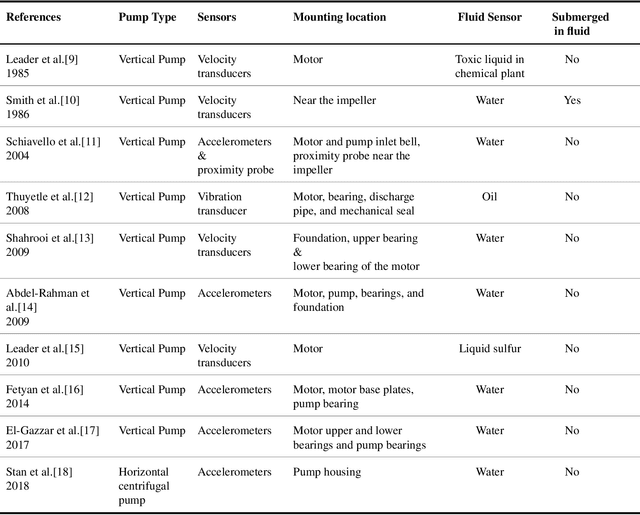
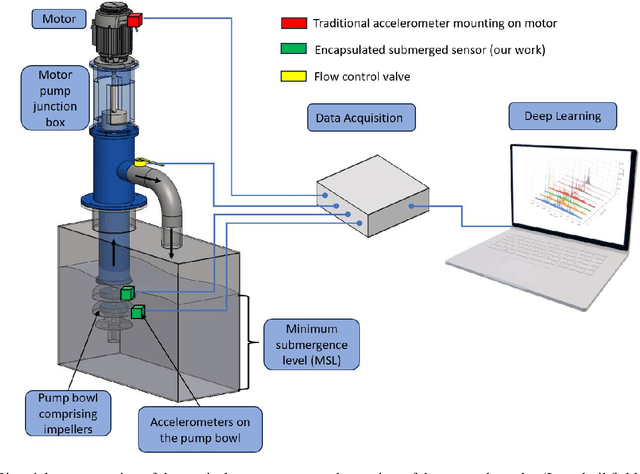
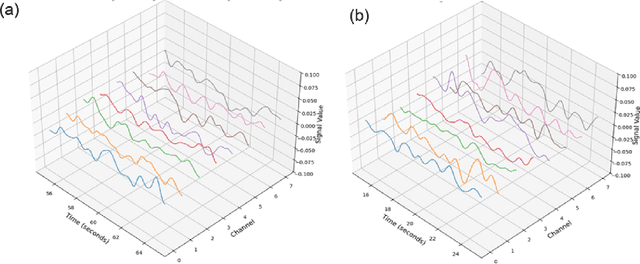
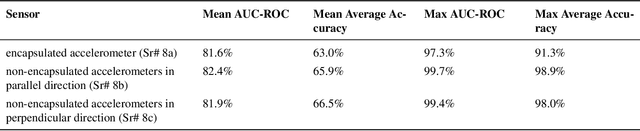
Vertical turbine pumps in oil and gas operations rely on motor-mounted accelerometers for condition monitoring. However, these sensors cannot detect faults at submerged impellers exposed to harsh downhole environments. We present the first study deploying encapsulated accelerometers mounted directly on submerged impeller bowls, enabling in-situ vibration monitoring. Using a lab-scale pump setup with 1-meter oil submergence, we collected vibration data under normal and simulated fault conditions. The data were analyzed using a suite of machine learning models -- spanning traditional and deep learning methods -- to evaluate sensor effectiveness. Impeller-mounted sensors achieved 91.3% average accuracy and 0.973 AUC-ROC, outperforming the best non-submerged sensor. Crucially, encapsulation caused no statistically significant performance loss in sensor performance, confirming its viability for oil-submerged environments. While the lab setup used shallow submergence, real-world pump impellers operate up to hundreds of meters underground -- well beyond the range of surface-mounted sensors. This first-of-its-kind in-situ monitoring system demonstrates that impeller-mounted sensors -- encapsulated for protection while preserving diagnostic fidelity -- can reliably detect faults in critical submerged pump components. By capturing localized vibration signatures that are undetectable from surface-mounted sensors, this approach enables earlier fault detection, reduces unplanned downtime, and optimizes maintenance for downhole systems in oil and gas operations.
HOTSPOT-YOLO: A Lightweight Deep Learning Attention-Driven Model for Detecting Thermal Anomalies in Drone-Based Solar Photovoltaic Inspections
Aug 26, 2025Thermal anomaly detection in solar photovoltaic (PV) systems is essential for ensuring operational efficiency and reducing maintenance costs. In this study, we developed and named HOTSPOT-YOLO, a lightweight artificial intelligence (AI) model that integrates an efficient convolutional neural network backbone and attention mechanisms to improve object detection. This model is specifically designed for drone-based thermal inspections of PV systems, addressing the unique challenges of detecting small and subtle thermal anomalies, such as hotspots and defective modules, while maintaining real-time performance. Experimental results demonstrate a mean average precision of 90.8%, reflecting a significant improvement over baseline object detection models. With a reduced computational load and robustness under diverse environmental conditions, HOTSPOT-YOLO offers a scalable and reliable solution for large-scale PV inspections. This work highlights the integration of advanced AI techniques with practical engineering applications, revolutionizing automated fault detection in renewable energy systems.